

When the person who invented the Professional Salon Microdermabrasion machine said this is the best way to exfoliate, we knew that it was the most effective product! This unique sponge is derived from the roots of the Konjac plant which is native to Asian countries and gently exfoliates dead skin cells and removes debris whilst cleansing the face. It leaves behind a ‘Colloid Film’ on the skin which nourishes, protects and hydrates your skin. It increases circulation and leaves the skin brightened and toned.
Konjac is naturally alkaline and PH neutral, with added antibacterial and antifungal properties to eliminate spots, blackheads and dead surface skin cells. It not only removes the correct amount of dead skin but is super effective at doing so with no over-exfoliating occurring which does happen with face gel and cream scrubs.
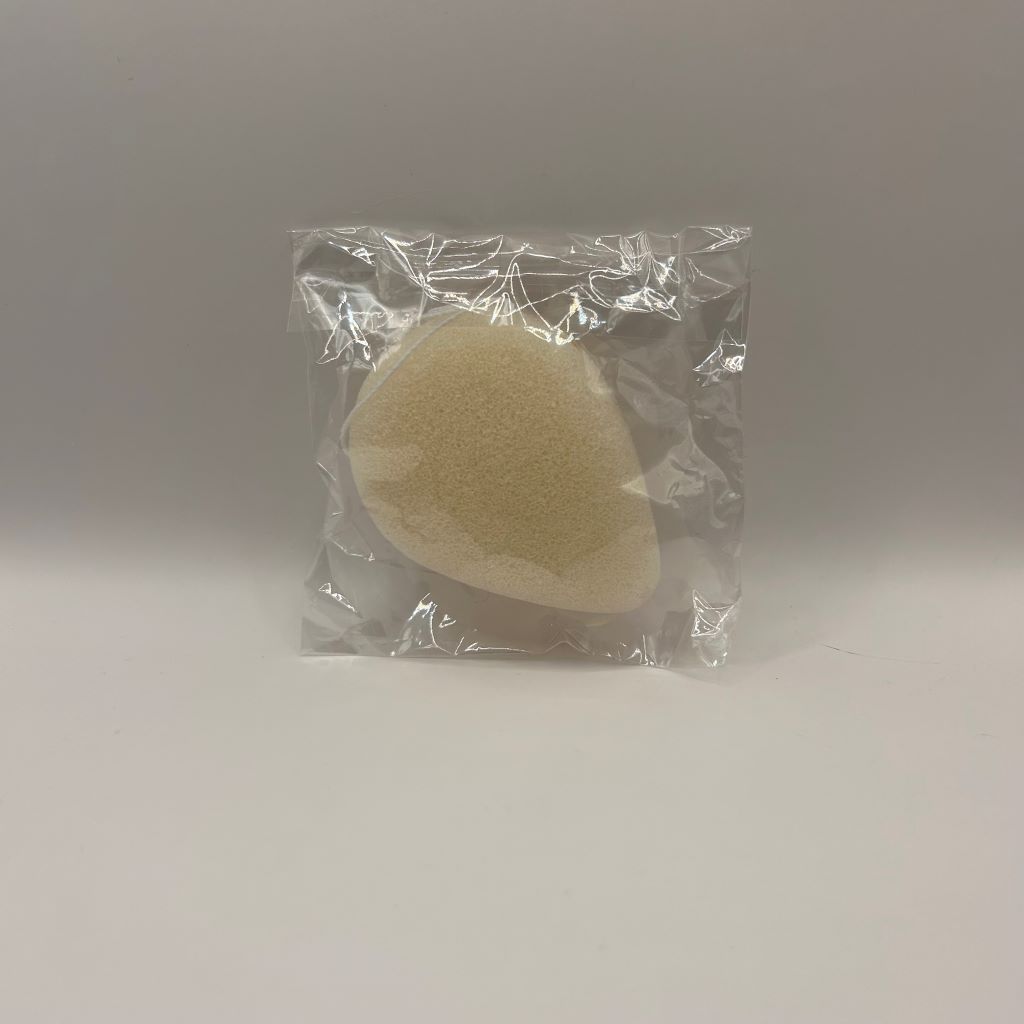
Why should you exfoliate: When you’re dead skin cells hang about too long it causes spots and dullness to the skin and this is the easy/perfect way to move them on. Simply keep it in the shower and use it 1-2 times a week. The Exfoliating Konjac Sponge is an innovative method of gentle exfoliation and a natural alternative to facial scrubs.
It gently massages the skin to stimulate blood flow and promote cell turnover, effectively removes dead skin cells and debris, cleansing the face while leaving a nourishing “Colloid Film” that hydrates and protects the skin. This process enhances circulation, resulting in a brighter, more toned complexion. The natural alkalinity and pH neutrality of Konjac, coupled with its’ antibacterial and antifungal properties, help eliminate blackheads, spots, and surface skin cells. Thus, when applying subsequent products, they are able to penetrate the skin more effectively revealing a more radiant complexion that feels beautifully soft and clean without any tightness or irritation. No over-exfoliating; only the right amount of dead skin is removed.
Please note the Konjac Exfoliating Sponge is 100% natural and biodegradable (it can go in your compost bin!) and so it lasts for around 8 weeks. It will last longer if water is squeezed out of it and it is hung up to dry after every use. Please also note, that this product is not a wash sponge and should not be used to remove make-up as this will degenerate the sponge.
Suitable for: All skin types; 100% natural and biodegradable, no microplastics here! Vegan
Interesting article from The Guardian:Ditching microbeads: the search for sustainable skincare: Amy DuFault Mon 5 May 2014 16.38 BST
As activists push for a ban on microbeads, cosmetic companies – and consumers – search for environmentally-friendly substitutes
Is smoother skin worth more than having potable water or edible fish?
For years, research has shown that beauty products made with tiny microbeads, gritty cleansers that scrub off dead skin cells, have been damaging water supplies, marine life and the ecological balance of the planet.
Beat the Microbead, an international campaign to ban the plastic beads, reports that marine species are unable to distinguish between food and microbeads. According to the campaign, “over 663 different species were negatively impacted by marine debris with approximately 11% of reported cases specifically related to the ingestion of microplastics”.
To make things worse, microbeads can act like tiny sponges, absorbing several other dangerous chemicals, including pesticides and flame retardants. As they ingest microbeads, marine animals also consume these other poisons.
The obvious solution to the microbead problem is to cut it off at the source. But while major cosmetic companies like Johnson & Johnson, Unilever, and Procter & Gamble have pledged to phase out the use of microbeads in favour of natural alternatives, they also say that the shift could take several years. And as more research is done, it appears that microbead replacements may come with dangers of their own.
Putting a face on a larger pollution problem
Most of the plastic pollution swirling in the ocean’s five major oceanic trash vortexes has stayed out of the collective consciousness, leaving the public with an “out of sight, out of mind” feeling of safety. But as microbeads rinse down drains and into lakes, oceans, and rivers, they are making it much harder for citizens to ignore the threat of plastic pollution.
This is becoming particularly pressing in Lake Erie, which acts as a bottleneck for all of the Great Lakes – and for the runoff from sewage treatment centres that are unable to contain the tiny plastic beads before they empty into the Saint Lawrence Seaway. 5Gyres, an organization aimed at reducing plastic ocean pollution worldwide, recently found a large number of microplastics in the Great Lakes. They estimate that one single care product, like Neutrogena’s Deep Clean, contains 360,000 microbeads in a single package.
Stiv Wilson, associate director for 5 Gyres, says that they discovered the Great Lakes plastic by accident. The group was looking for photo-degraded micro-plastics, similar to those found in the ocean. Instead, they found microbead concentrations of 450,000 per square kilometer in Lake Erie.
“What we recognized in sample analysis from the Great Lakes was that these were primary source plastic pollutants, not the typical photo degraded types found in the ocean,” says Wilson, adding that the microbeads really stood out on the calm lake surface. In the five oceanic gyres, plastics have been broken down by sunlight, and are harder to see.
Going to the source
Following on the success of a collaborative social media campaign with the Plastic Soup Foundation that led to Unilever’s commitment to phase out the microbeads, 5 Gyres went after other companies including Proctor & Gamble, Johnson & Johnson, The Body Shop, and L’Oreal.
“P&G brushed us off, and we bombed them with 15,000 letters and absolutely shut down their email communications at the VP level for several days. Finally, they sent one email that said they’d discontinue using beads by the end of 2017,” Wilson says. “That was in June, 2013.”
Five Gyres wasn’t satisfied with that timeline and continued to send letters, pushing for a 2015 phase out, Wilson says. However, as of this article, P&G still hasn’t provided more information to 5 Gyres as to when that phase out will occur.
“To say any of them have been real proactive is a stretch because the phase out was nonbinding, and the dates became moving targets,” says Wilson, adding that the Personal Care Products Lobby have said they need a long time to “reformulate.”
“We can’t get a straight answer from any producer,” Wilson says.
Reduce the demand to reduce the supply?
Working with big business isn’t the only way 5 Gyres is working to create change and awareness. The non-profit has also shifted some of the responsibility to consumers with a recently released platform called “Beat The Microbead“. The sub-site and app, both of which were developed in-house, allow consumers to scan the barcode of personal care products to determine whether they contain plastic microbeads and whether the manufacturer has agreed to remove them or not.
There are also other tools for educated consumers who wish to environmentally navigate the sea of microbead infused products: in addition to the “Beat the Microbead” app, Fauna & Flora International has created The Good Scrub Guide, a listing of face scrubs that are free from plastic microbeads and that are currently available on the UK market.
Tanya Cox, project officer of marine plastics for Fauna & Flora International, and Wilson’s “international partner,” says she is hoping to increase the scope and user-friendliness of the guide in the future and make it available for more countries where FFI works. Brands wishing to feature their products on the guide must first confirm with Cox that the product is free from solid, plastic microbeads made from polyethylene, polypropylene, polyethyl-terephthalate (PET), polymethyl methacrylate (PMMA) and nylon.
Legal protections
Another route for combating microbeads is through laws restricting their use. Currently, 5 Gyres is working with New York, California, Minnesota and Illinois to prohibit the sale of personal care products containing microbeads. New York and California are already leading the way: this past February, they introduced legislation to ban microplastics in cosmetics. Cox says that these laws could have long-reaching effects that extend far beyond the boundaries of the US. “We, the wider group of international NGOs working on this issue, are also looking at ways that existing European law can be altered to encompass something like this. But progress is likely to be much slower unfortunately,” Cox says.
“We are excited to see the outcome of legislation in the States because it may mean that large multi-nationals such as Johnson & Johnson and Proctor & Gamble will simply phase out microbead use globally in a much shorter timeframe than currently being discussed.”
The EU, which touts a “Precautionary Principle” to restrict and ban substances that might be harmful to humans, is leading the way for other countries to be accountable when companies refuse to. The U.S. is much more lenient. In fact, To date, the EU has banned 1,100 chemicals in cosmetics while the Food and Drug Administration in America has banned only ten.
Natural alternatives
Some of the natural replacements for microbeads also have negative consequences. Greg Boyer, chair of the chemistry department at SUNY-College of Environmental Science and Forestry, says a possible negative consequence is with degrading sugars that biochemically “burn” the sugar for energy.
“If you have any type of stratified water column – there may not be enough oxygen present to support this process, hence the bacteria draw down the oxygen to a point where fish and other critters die,” says Boyer, adding that a classic example is the Lake Erie deadzones where the bottom water layer is very thin.
“The algae grow in the top water, settle down to the bottom waters and the bacteria decompose them and use all the available oxygen in the bottom waters,” he says. “Adding a natural carbon source, either sugar or nut shell, would only make the problem worse.” Because synthetic microplastic beads don’t degrade well, they don’t tend to cause this problem.
Wilson argues, however, that this biodegradability is actually a key strength for non-microbead abrasives. “As long as the alternatives are sourced sustainably, my feeling is that their legacy in the natural environment – post-consumer use – will be much lower than that of microplastics,” he says.
A variety of biodegradable ingredients are available to developers. Victoria Fantauzzi, co-founder of Chicago-based La Bella Figura Beauty, says that her company recently released a facial cleanser that uses enzymes found in papaya and pineapple, ingredients known to effectively exfoliate skin cells.
Fantauzzi points out that another company, Odacite, uses natural exfoliants like jojoba beads, which are made from a biodegradable natural wax. She says that, while jojoba beads exfoliate in much the same way as microbeads, they are a gentler alternative and are less likely to harm sewer systems or the environment.
Unfortunately, Fantauzzi says, there’s a catch: sustainable ingredients often cost more – and can have a more problematic supply chain. “Non-sustainable businesses seem to lose ethics when it comes to sourcing ingredients,” she explains. “They pay cheaply and in the interim rainforests are destroyed or farmers lose business as their product gets outsourced to a different grower willing to take the cost hit.”
This can have a devastating effect on farming communities: “In some cases, as in Mexico, they lose generations of family farms to companies who come in to produce cheap crops using cheap labour and GMO seeds,” Fantauzzi adds.
But, she says, if smaller companies like hers can commit to providing microbead-free scrub options, then there should be no reason a larger, better known company can’t. “It’s all about being dedicated to change but the truth is, even those resistant companies will have no choice in becoming compliant with these new laws. They will have to be or they will not be allowed to retail in a growing billion dollar market like the EU,” Fantauzzi says.
“It’s really about being committed to change and how you want to sleep every night,” she adds.